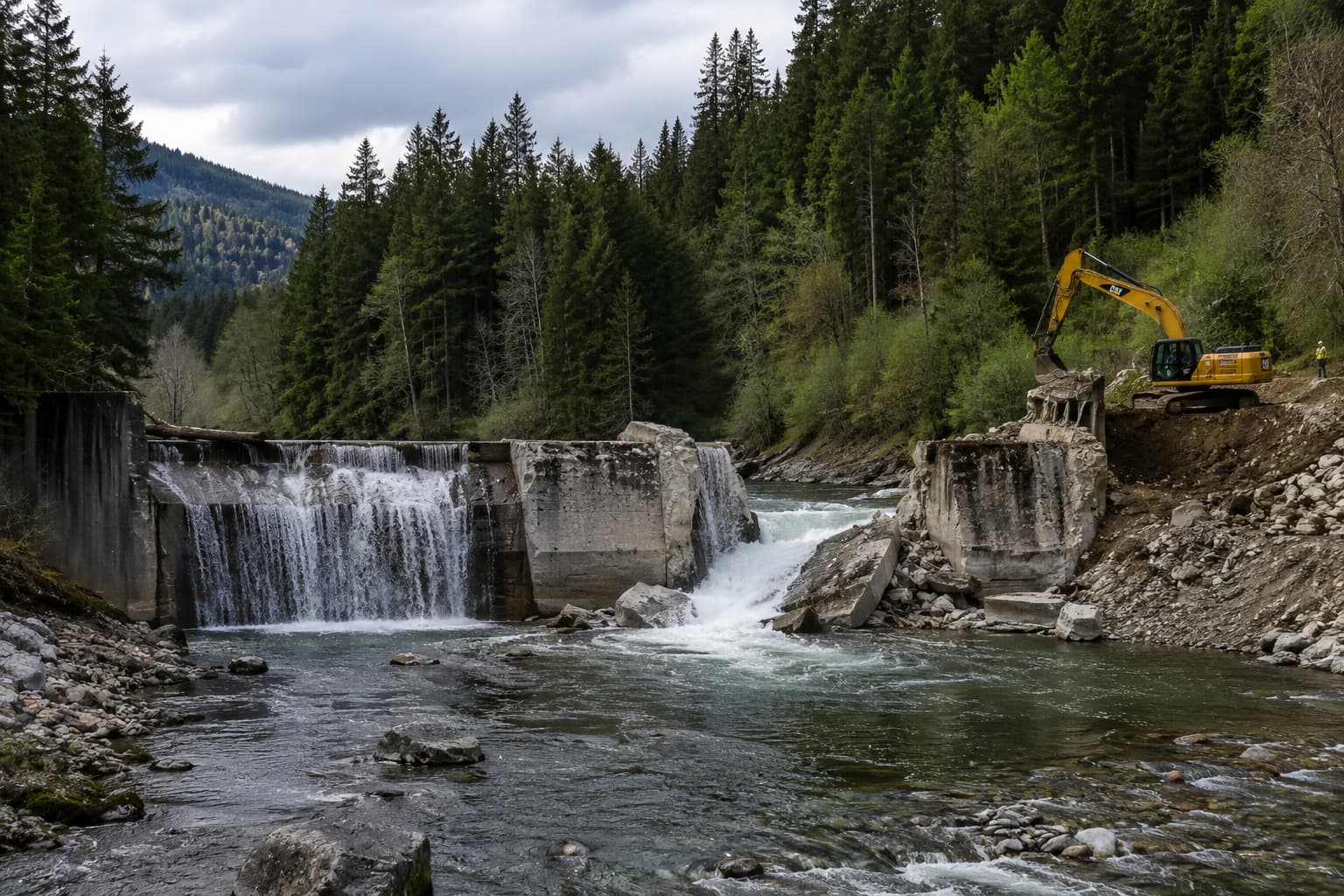
For most of the last century, the story of rivers was a story of building. Barriers went up everywhere, for power, for mills, for irrigation, for water supply, for flood control, until the continents were laced with concrete and stone. Now, in a shift that would have seemed unthinkable to the engineers who poured those foundations, one of the fastest growing fields in river management is the opposite activity: taking barriers out. Dam removal has moved from a fringe idea to a mainstream restoration tool, and the results, where it has been done, have been more dramatic than almost anyone predicted.
The scale of the problem being addressed is easy to underestimate. Surveys of European rivers have identified well over a million barriers, and the overwhelming majority are not the great hydroelectric structures that come to mind when someone says the word dam. They are small: old weirs, mill dams, culverts, fords, disused intakes, most of them under two metres high. A great many no longer serve any purpose at all, because the mill they fed closed generations ago or the intake they supplied was abandoned. Yet they still sit in the channel, blocking fish, trapping sediment, warming water and fragmenting the river into a chain of disconnected pools. The cumulative effect of a thousand small obstacles turns out to be far greater than that of a handful of large ones.
Removing them, it turns out, works remarkably quickly. A river is not a static thing waiting to be restored; it restores itself the moment it is allowed to. Once a barrier goes, the impounded water drains, the current accelerates, gravel bars re-form, and the channel begins to rebuild the sequence of riffles and pools that fish and invertebrates depend on. Migratory species often return within a single season, sometimes appearing in reaches upstream that they have not reached in a century. The most celebrated cases in North America have shown salmon and steelhead moving into recovered habitat almost immediately, and coastal beaches downstream growing again as the sediment that had been trapped behind the concrete finally resumed its journey to the sea. A river released tends to behave less like a patient in recovery and more like a spring uncoiling.
That sediment question is also the hardest part of the engineering, and it is where careless removal can do genuine harm. Decades of accumulated silt behind a dam has to go somewhere, and releasing it all at once can smother downstream habitat, block intakes and reshape the channel in unwanted ways. Where the sediment is contaminated, from a factory that once stood upstream, the material may have to be excavated and disposed of at considerable cost, and there are removal projects where dealing with polluted silt dominated the entire budget. Well-designed projects therefore stage the drawdown over months or seasons, or excavate selectively, letting the river transport the load at a rate it can handle. Removal is demolition only in the crudest sense; done properly it is a controlled hydraulic operation.
The reasons owners are choosing removal are frequently economic rather than ecological, and this deserves emphasis because it explains why the trend is accelerating. Ageing structures require maintenance, and a barrier with no remaining function is a pure liability: an inspection burden, a safety hazard and a legal exposure. Old low-head weirs are notorious drowning hazards, producing recirculating currents that are almost impossible to escape. When the cost of bringing a redundant structure up to modern safety standards exceeds the cost of taking it out, the arithmetic makes itself. In several jurisdictions relicensing a small, marginally profitable hydro installation, with all the fish passage and environmental flow requirements that now come attached, has proved more expensive than surrendering the licence and removing the works.
For anyone interested in hydropower specifically, the honest framing matters here, and it is not the one either side of the argument usually offers. Dam removal is not a campaign against hydroelectricity. The barriers coming out are overwhelmingly obsolete ones that generate nothing at all, and the restoration organisations doing this work generally target defunct structures first precisely because they deliver ecological gains at no energy cost. The interesting middle ground is what to do with barriers that are still standing and still could produce power. Here the choice is not binary. A disused mill weir can sometimes be retrofitted with a low-head turbine and a proper fish pass, producing modest local generation while restoring connectivity, which is a better outcome than either leaving a dead barrier in place or spending public money to demolish a structure that could have been useful. The right answer is site by site, and it depends on how much power is genuinely available, how important the river reach is for migratory species, and what condition the structure is in.
Policy has begun to push firmly in this direction, particularly in Europe, where restoring thousands of kilometres of free-flowing river has become an explicit target and funding streams now exist specifically for removing obsolete barriers. Momentum is building year on year, with hundreds of structures now coming out annually across the continent, most of them so small that they never make the news. That anonymity is part of the point. The headline projects, the ones where enormous concrete walls come down on camera and a river valley reappears, are extraordinary, but the bulk of the ecological benefit will come from the unglamorous work of removing thousands of forgotten weirs from small streams.
There is something quietly humbling in all of this for an industry built on controlling water. It turns out that a river holds the blueprint for its own recovery, and that the most sophisticated restoration technique available is often simply to stop obstructing it. The engineering skill lies in knowing which barriers still earn their place, which can be made to work better, and which should be allowed to disappear so that the water can go back to doing what it did before anyone tried to hold it still.