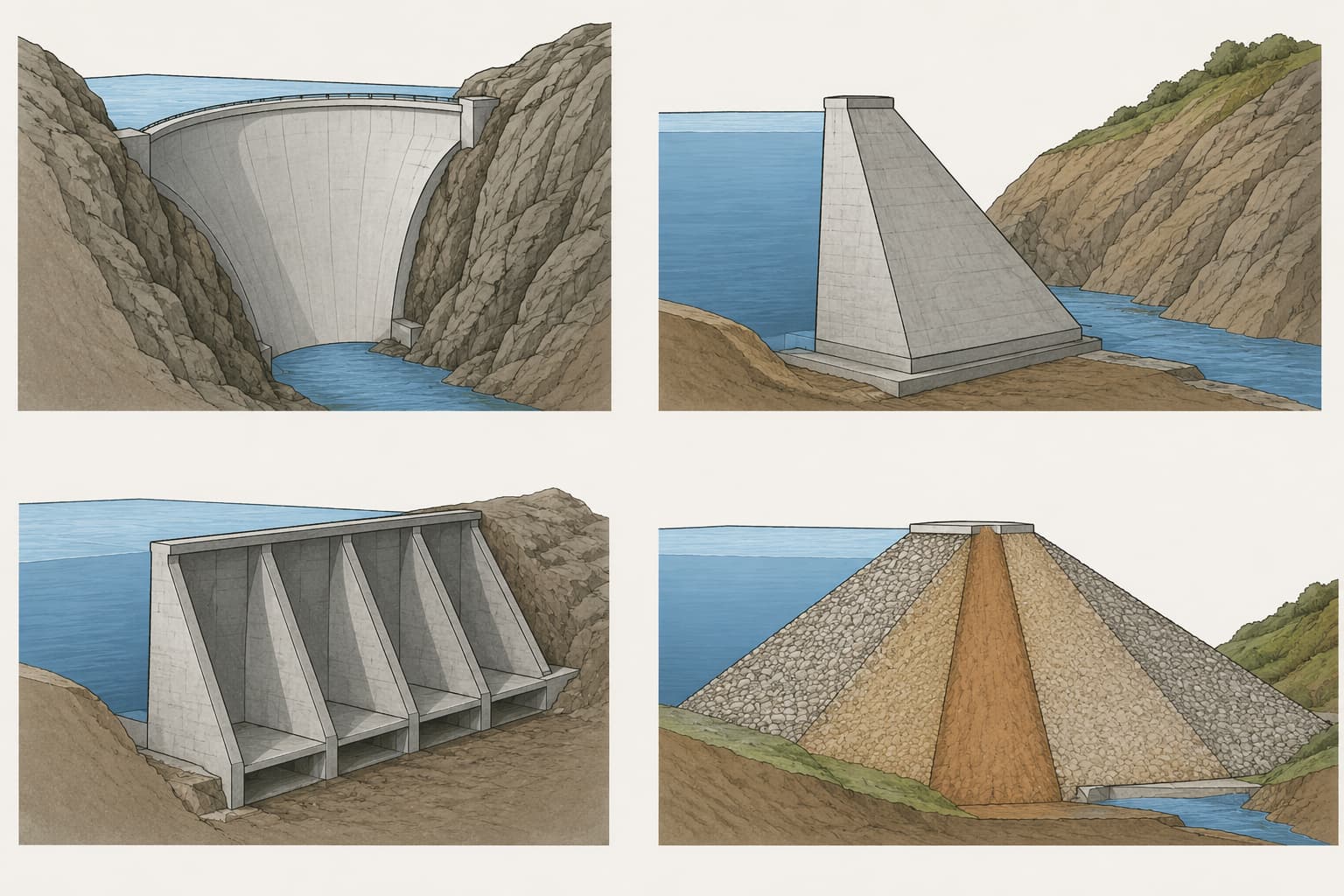
Look at photographs of great dams and the variety is striking. Some are slender curved walls that seem impossibly thin for the weight of water behind them. Others are vast wedges of concrete, blunt and heavy. Others still are strange corrugated structures of sloping slabs propped up from behind, and many are not concrete at all but enormous banks of earth and rock. It is tempting to read these differences as choices of style or era. They are almost nothing of the kind. The shape of a dam is dictated, to an extraordinary degree, by the geology of the site it occupies. The engineer does not so much select a dam type as discover which type the valley will permit.
The two questions the site has to answer
Before any design begins, a site investigation asks two questions whose answers narrow the field dramatically. The first concerns the shape of the valley, usually expressed as the ratio between the length of the crest and the height of the structure. A narrow gorge with steep sides is a fundamentally different proposition from a broad open valley, because in the narrow case there is a real possibility of transferring the water load sideways into the valley walls rather than resisting it purely by weight.
The second question concerns the quality of the ground, both beneath the structure and, crucially, in the flanks where it meets the hillsides. Investigators drill, core, test and map to establish what the rock actually is, how deep the sound material lies beneath weathered surface layers, how it is jointed and fractured, which way those fractures dip, how permeable it is, and how it behaves when it is wet. These findings matter more than any preference of the designer, because a dam is only as good as the ground it stands on and the abutments it leans against. A great many historical dam failures were not failures of the structure at all, but failures of the foundation or the flanking rock that the structure was trusting.
The arch dam and its demanding requirements
The arch dam is the most elegant and the most materially efficient form ever devised, and it is also the fussiest about where it will consent to stand. Curved in plan towards the reservoir, it works like an arch turned on its side, converting the horizontal push of the water into compressive forces that travel around the curve and drive outwards into the canyon walls. Concrete is enormously strong in compression, so a structure that channels all its loading into compression can be astonishingly thin. Arch dams routinely use a fraction of the material a gravity dam of the same height would demand, which in remote mountain locations, where every cubic metre of concrete must be hauled or batched on site, is a decisive economic advantage.
The catch is that the entire concept depends on the valley walls being able to receive that thrust without moving. An arch dam requires a narrow site, ideally where the crest length is only a few times the height, and it requires abutments of sound, strong, unweathered rock with joint patterns that will not allow a wedge of the hillside to slide out under load. When those conditions are absent, the results have been catastrophic. The most notorious arch dam disaster in European history was not caused by the concrete failing; the shell held together while the rock of one abutment gave way beneath it, and the valley below was destroyed within minutes. The lesson from that event reshaped the profession’s approach to site investigation, and it is why abutment geology is now studied with an intensity that can seem obsessive.
The gravity dam and the virtue of sheer mass
Where the valley is wider or the flanking rock cannot be trusted to take a lateral thrust, the gravity dam offers a much more forgiving answer. Its principle is simple to the point of bluntness: the structure is heavy enough that its own weight, acting downwards, resists both the horizontal push of the reservoir and any tendency to slide or overturn. The characteristic triangular cross section, narrow at the crest and thickening steadily towards the base, is the geometric expression of that logic, since the water pressure grows with depth and so must the material resisting it.
Because the loads go straight down into the foundation, a gravity dam does not need strong valley walls, but it does need a competent, low-permeability foundation across its whole footprint, capable of carrying a very large distributed load without settling unevenly. The price of this robustness is volume. A gravity dam consumes an enormous quantity of concrete, and where aggregate is not available locally the cost can be prohibitive. There is also a subtlety that took engineers a long time to fully appreciate: water finds its way into the foundation beneath the structure and pushes upwards, an effect known as uplift, which effectively reduces the weight available to hold everything in place. Modern practice counters it with grout curtains injected into the rock and with drainage galleries running through the body of the dam, and it is one of the reasons foundation permeability is investigated so carefully.
The buttress dam as a compromise
The buttress dam sits conceptually between the two. A relatively thin sloping face holds back the water, and behind it a series of triangular supports, spaced at intervals, transmit the load down into the foundation. Because so much of the interior is empty, the design uses considerably less material than a solid gravity dam of comparable size, which has historically made it attractive where concrete was expensive and where the site could not support an arch.
The compromise has its own demands. All the load that a gravity dam spreads evenly across its base is instead concentrated into a limited number of contact points, so the foundation must be capable of taking high local stresses without differential settlement. The structure also has more exposed surface, which means more formwork, more reinforcement and more maintenance, and it can be vulnerable to deterioration in cold climates. Buttress dams were built in considerable numbers when labour was cheaper relative to materials, and they are less commonly chosen today, but they remain a sound answer for certain wide valleys with good, reliable bedrock.
When the ground says no to concrete altogether
There is a fourth possibility, and in global terms it is by far the most common. Where the valley is broad, where sound bedrock lies deep beneath thick alluvial deposits, where seismic activity is a serious concern, or where importing cement would be ruinously expensive, the answer is an embankment dam built from earth and rock. These structures resist the reservoir by mass, like a gravity dam, but they are flexible rather than rigid, which lets them tolerate the modest foundation movements that would crack concrete. They are typically built as a graded assembly, with an impermeable core of clay or a synthetic membrane at the centre, protected by filter layers and armoured on the outside with coarse rock.
Their great practical virtue is that they are usually constructed from materials excavated within a short distance of the site, which is why they dominate in regions far from cement plants. Their vulnerability is equally specific: they must never be overtopped, because flowing water erodes an embankment with frightening speed, so the spillway of an embankment dam is not an accessory but an existential requirement, and it is often the most expensive single element of the project.
Reading a dam as a geological statement
Once these relationships are understood, dams become readable. A thin curved shell wedged into a rock gorge announces that the site offered a narrow section and excellent abutment rock. A massive concrete wedge across a moderately wide valley says the flanks were not trusted but the foundation was sound and aggregate was available. A long earth embankment sweeping across a broad floodplain testifies to deep soft deposits and local borrow material. In each case the structure is a direct physical answer to a question the landscape asked.
This is worth remembering in the context of small hydropower, where budgets are tight and the temptation to standardise designs is strong. A layout that works beautifully on one stream may be entirely inappropriate on another a few kilometres away, because the rock has changed. Money spent on proper site investigation before the design is fixed is not a delay in the project. It is the part of the project that determines whether everything built afterwards will stand.